


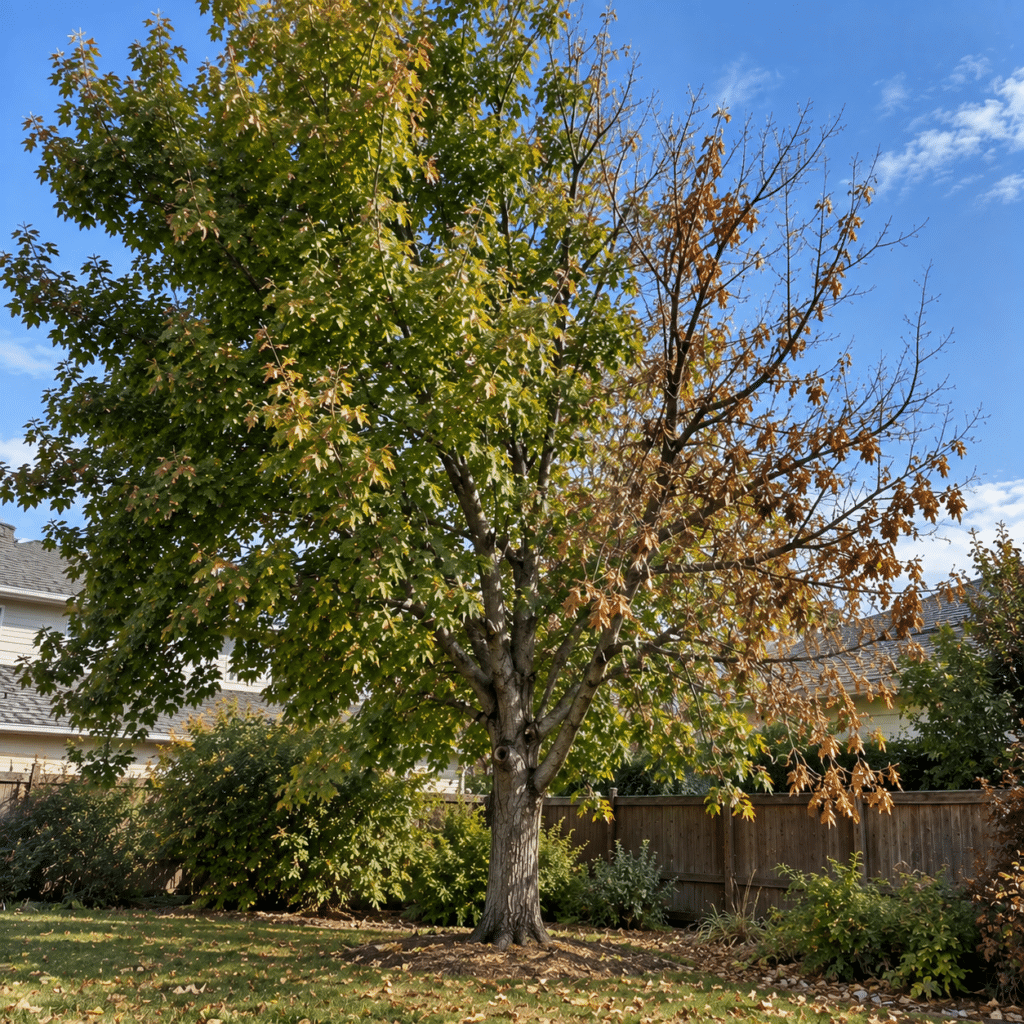
One-sided die-off in a maple tree usually points to a problem below the surface. Root damage, disease, pest infestation, or a blocked vascular system can all cut off water and nutrients to part of the tree. The affected side starves while the rest of the tree survives, at least for a while. Early evaluation by a certified arborist gives you the best chance of saving it.
A homeowner in Genoa, NV recently called us about two maple trees in her backyard. One side of each tree looked like it was fading fast. She put it simply: she needed a tree doctor. That call reminded us how often homeowners spot this exact symptom and are not sure whether it means trim, treat, or remove.
At Joe Benigno’s Tree Service, we handle this kind of situation regularly. Here is what we know about one-sided die-off and what you should do if you are seeing it on your property.
What causes a tree to die on just one side?
The most common causes are root damage, fungal disease, pest activity, or physical injury to the trunk or limbs on that side. Trees have a vascular system that moves water and nutrients from the roots up through the trunk and out to the branches. When something disrupts that flow on one side, that side dies back while the rest of the tree keeps going.
Here are the most frequent culprits we see in the Genoa area:
- Root damage from construction, soil compaction, or nearby utility work
- Verticillium wilt, a soil-borne fungal disease that maples are especially prone to
- Bark damage or girdling caused by lawn equipment, animals, or tight ties
- Borer insects tunneling through the wood on one side of the trunk
- Drought stress combined with root zone problems, which is very common in Nevada’s dry climate
Maples are beautiful trees, but they are not especially tough when their roots or vascular system get compromised. The good news is that with the right diagnosis, many of them can be saved.
How do you know if a maple tree can still be saved?
The tree’s chances depend on how much of it is affected, what is causing the problem, and how long it has been going on. A certified arborist can scratch a small section of bark to check for living tissue underneath, look for signs of fungal growth or insect galleries, and assess the root zone.
Signs that treatment may still work:
- Less than half the canopy is affected
- The bark on the healthy side is firm and intact
- New growth is still appearing somewhere on the tree
- The tree has no visible trunk cavities or major structural cracks
If the damage is too advanced or the disease has spread through most of the root system, removal may be the safer and more honest recommendation. Our team will always tell you the truth about what we find. You can learn more about that process on our tree removal service page.
What does a certified arborist actually do during an evaluation?
A certified arborist does a full visual inspection of the tree, from the soil line up to the canopy, looking for signs of disease, pest activity, structural weakness, and root stress. They are trained to read symptoms that most homeowners would not recognize as warning signs.
After the inspection, they give you a clear picture of what is happening and what your options are. That might mean a targeted treatment plan, pruning to remove the dead wood, soil care, or in some cases a recommendation for removal. Learn more about our plant healthcare and arborist services to see what a full evaluation looks like.
Our certified arborist, Rebecca, handles these evaluations personally. If you want to know more about our team and how long we have been doing this work, visit our about page.
Frequently Asked Questions
Can I treat a maple tree myself if one side is dying?
DIY treatments are rarely effective without knowing the exact cause. Applying the wrong fungicide or fertilizer can make things worse. A professional diagnosis is the right first step before any treatment is applied.
Is one-sided die-off always a sign the tree needs to be removed?
Not always. If the problem is caught early and the cause is treatable, many trees recover fully or at least stabilize. Removal is a last resort, not a default. An arborist evaluation will tell you where your tree actually stands.
Are maple trees in Nevada more vulnerable to this kind of damage?
Yes. Maples prefer moisture-rich environments, and Nevada’s dry conditions put them under constant stress. That stress makes them more susceptible to disease and pest pressure, especially during drought years. Proper watering and soil care make a real difference.
Get Your Trees Evaluated by a Certified Arborist in Genoa, NV
If one of your trees is showing signs of one-sided die-off, do not wait to see if it gets better on its own. It usually does not. The sooner an arborist takes a look, the more options you have.
We serve homeowners throughout Genoa, NV and the surrounding area. Contact us today to schedule an arborist evaluation and find out exactly what your trees need.
